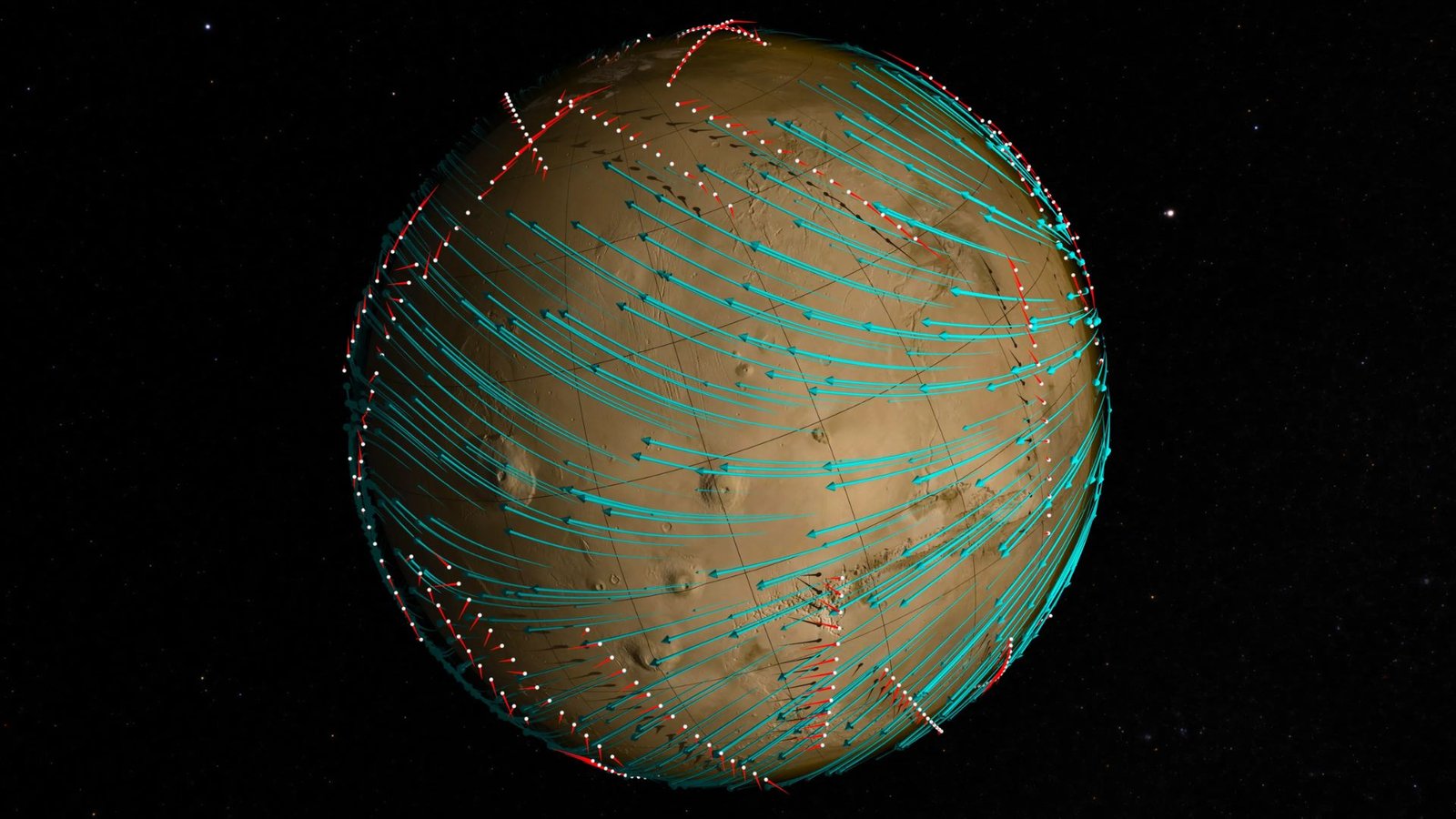
Researchers are developing advanced models to simulate wind-driven ocean waves on celestial bodies beyond Earth, including Mars, Titan (a moon of Saturn), and various exoplanets. This research, published in the ESS Open Archive, aims to deepen our understanding of planetary environments and their potential habitability. The models incorporate complex factors such as atmospheric conditions, surface properties, and gravitational forces to accurately represent wave behavior on these distant worlds.
Understanding wave dynamics is crucial for several reasons. On Mars, ancient shorelines provide evidence of past oceans, and studying wave action can help determine the size, depth, and duration of these bodies of water. On Titan, which boasts hydrocarbon lakes and seas, wave models can shed light on the composition and behavior of these unique liquid environments. Furthermore, understanding waves on exoplanets, particularly those within habitable zones, can offer insights into their climate, weather patterns, and overall suitability for life.
Modeling Challenges
Modeling waves on other planets presents significant challenges. Atmospheric densities and compositions vary drastically, impacting wind speeds and wave formation. Surface properties, such as the presence of ice, rock, or liquid hydrocarbons, also influence wave characteristics. Additionally, gravitational forces on these bodies differ from Earth, affecting wave height, wavelength, and propagation speed. The models must account for these variables to produce reliable simulations.
The researchers are utilizing computational fluid dynamics (CFD) techniques, coupled with observational data from spacecraft missions and remote sensing instruments, to validate their models. For example, data from the Cassini-Huygens mission has provided valuable information about Titan’s lakes and seas, enabling scientists to refine their wave models for this intriguing moon. Similarly, data from Mars rovers and orbiters contribute to understanding the planet’s past and present hydrological conditions.
Implications for Habitability
The ability to accurately model wave dynamics has profound implications for assessing the habitability of other planets. Waves play a critical role in mixing and transporting energy, nutrients, and gases within oceans and lakes. This mixing can influence the distribution of heat, the availability of resources for potential life forms, and the overall stability of aquatic ecosystems. By understanding wave behavior, scientists can better evaluate the potential for life to exist on other planets and moons.
Moreover, these models can assist in the design of future missions to explore these worlds. Knowing the expected wave conditions on bodies like Titan can inform the development of submersible probes or autonomous vehicles capable of navigating these challenging environments. This research not only advances our scientific understanding but also paves the way for future exploration and discovery in the vast expanse of our solar system and beyond. The continued refinement of these models promises to unlock further secrets about the potential for life beyond Earth.
Image Source: Google | Image Credit: Respective Owner