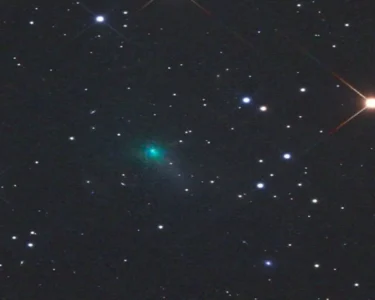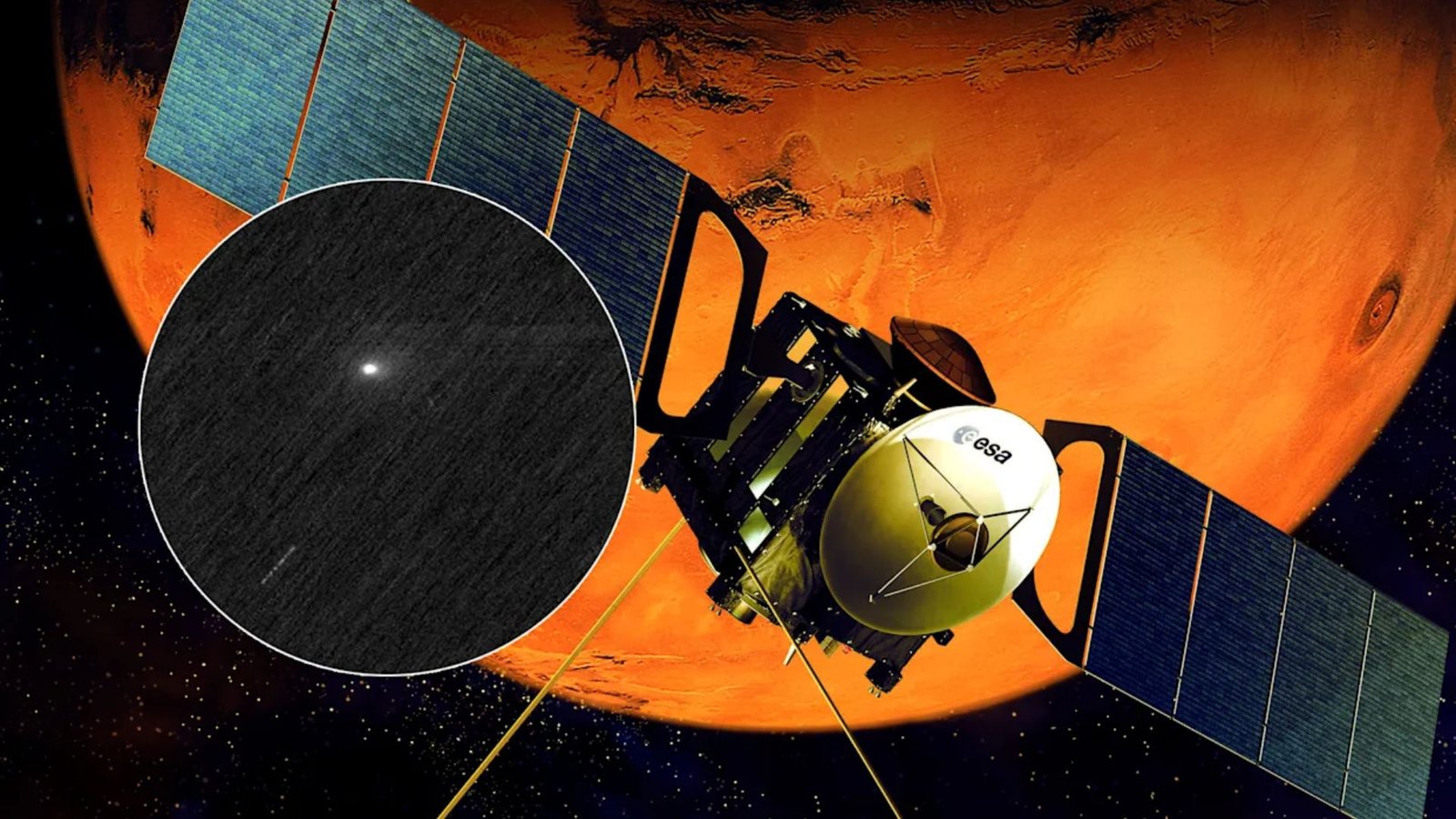
In an unprecedented astronomical feat, Mars orbiters have successfully captured the closest images yet of the rare interstellar visitor, comet 3I/ATLAS. This marks a significant milestone in space exploration, providing invaluable data and breathtaking visuals of an object originating from outside our solar system.
The comet, officially designated 3I/ATLAS, was first discovered in 2017 and quickly gained attention for its hyperbolic trajectory, indicating its interstellar origin. Unlike comets that orbit our Sun, 3I/ATLAS is just passing through, making its observation a fleeting but crucial opportunity for scientists.
Unprecedented Observations
The collaborative effort involved multiple Mars orbiters, including NASA’s Mars Reconnaissance Orbiter (MRO) and the European Space Agency’s (ESA) Mars Express. These spacecraft were strategically positioned to observe the comet as it made its closest approach to Mars. The high-resolution cameras and sophisticated instruments aboard these orbiters enabled scientists to capture detailed images and collect spectral data of the comet’s nucleus and coma – the cloud of gas and dust surrounding the nucleus.
“These observations are truly remarkable,” stated Dr. Emily Carter, lead researcher at the Space Science Institute. “The proximity of the Mars orbiters allowed us to obtain images with unprecedented clarity, revealing intricate details about the comet’s composition and structure. This information is critical for understanding the formation and evolution of interstellar objects.”
The images reveal a relatively small nucleus, estimated to be only a few kilometers in diameter, surrounded by a diffuse coma extending thousands of kilometers into space. Spectral analysis indicates the presence of various volatile compounds, including water ice, carbon dioxide, and other organic molecules. These findings support the theory that comets, including interstellar ones, played a crucial role in delivering water and organic building blocks to the early Earth and potentially other planets.
Scientific Significance
The observations of 3I/ATLAS provide a unique window into the composition and environment of other star systems. By studying interstellar objects like 3I/ATLAS, scientists can gain insights into the processes that shape planetary systems beyond our own. The data collected will help to refine models of comet formation, interstellar dust composition, and the dynamics of interstellar space.
“The study of interstellar objects is a rapidly evolving field,” explained Dr. David Lee, an astrophysicist at the Harvard-Smithsonian Center for Astrophysics. “These objects offer a direct sample of materials from other star systems, allowing us to test our theories about the universality of chemical processes and the potential for life beyond Earth. The observations of 3I/ATLAS are a significant step forward in this endeavor.”
The data obtained from the Mars orbiters will continue to be analyzed in the coming months and years, promising further discoveries and a deeper understanding of the cosmos. The successful capture of these images underscores the importance of international collaboration in space exploration and the power of robotic missions to unlock the secrets of the universe. The findings are expected to be published in several leading scientific journals, contributing to a growing body of knowledge about interstellar objects and their role in the evolution of planetary systems.
Image Source: Google | Image Credit: Respective Owner