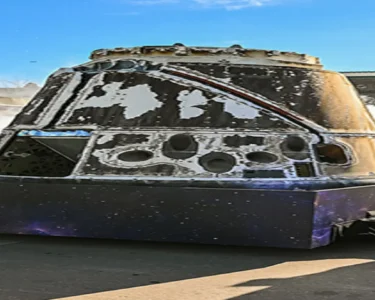
SpaceX launched its 11th test flight of Starship, pushing the boundaries of space exploration with an ambitious goal to cover half the globe. The uncrewed Starship prototype, designated as a developmental vehicle, lifted off from the company’s Starbase facility near Brownsville, Texas. This latest iteration builds upon previous tests, incorporating lessons learned to improve the vehicle’s performance and reliability. The primary objective of this flight is to assess Starship’s ability to withstand the extreme conditions of atmospheric re-entry, a critical phase for future orbital missions.
The flight profile involved a planned ascent to a predetermined altitude, followed by a controlled descent and a simulated landing burn. SpaceX engineers meticulously monitored telemetry data throughout the flight, evaluating the performance of Starship’s Raptor engines, heat shield, and aerodynamic control surfaces. The ambitious ‘half-globe’ trajectory aimed to demonstrate the vehicle’s long-range capabilities and its potential for rapid global transport in the future.
Advancements and Challenges
Each Starship test flight represents a significant step forward in SpaceX’s development program. Previous flights have provided valuable insights into the vehicle’s structural integrity, engine performance, and control systems. However, these tests have also encountered challenges, including landing failures and engine anomalies. SpaceX has addressed these issues through continuous design improvements and rigorous testing.
The heat shield, composed of hexagonal tiles, is particularly crucial for protecting Starship during re-entry. The extreme heat generated as the vehicle plunges through the atmosphere can cause significant damage if the heat shield is not functioning correctly. SpaceX has implemented advanced materials and manufacturing techniques to enhance the heat shield’s durability and effectiveness.
The Raptor engines, powered by liquid methane and liquid oxygen, are designed to provide the immense thrust required for Starship’s ascent and landing. These engines are significantly more powerful and efficient than previous generations of rocket engines. SpaceX is continuously refining the Raptor engine design to improve its performance and reliability.
Future Implications
SpaceX envisions Starship as a fully reusable transportation system capable of carrying humans and cargo to the Moon, Mars, and beyond. The company plans to use Starship to establish a permanent human presence on Mars, paving the way for future interplanetary exploration and colonization. The successful development of Starship would revolutionize space travel, making it more affordable and accessible.
The half-globe flight test is a critical milestone in achieving these ambitious goals. By demonstrating Starship’s long-range capabilities and its ability to withstand the rigors of space travel, SpaceX is taking a significant step towards realizing its vision of becoming a multi-planetary species. The data collected from this test will be invaluable in guiding future Starship development and mission planning. SpaceX continues to push the boundaries of what’s possible, driving innovation in the space industry and inspiring future generations of scientists and engineers.
Image Source: Google | Image Credit: Respective Owner