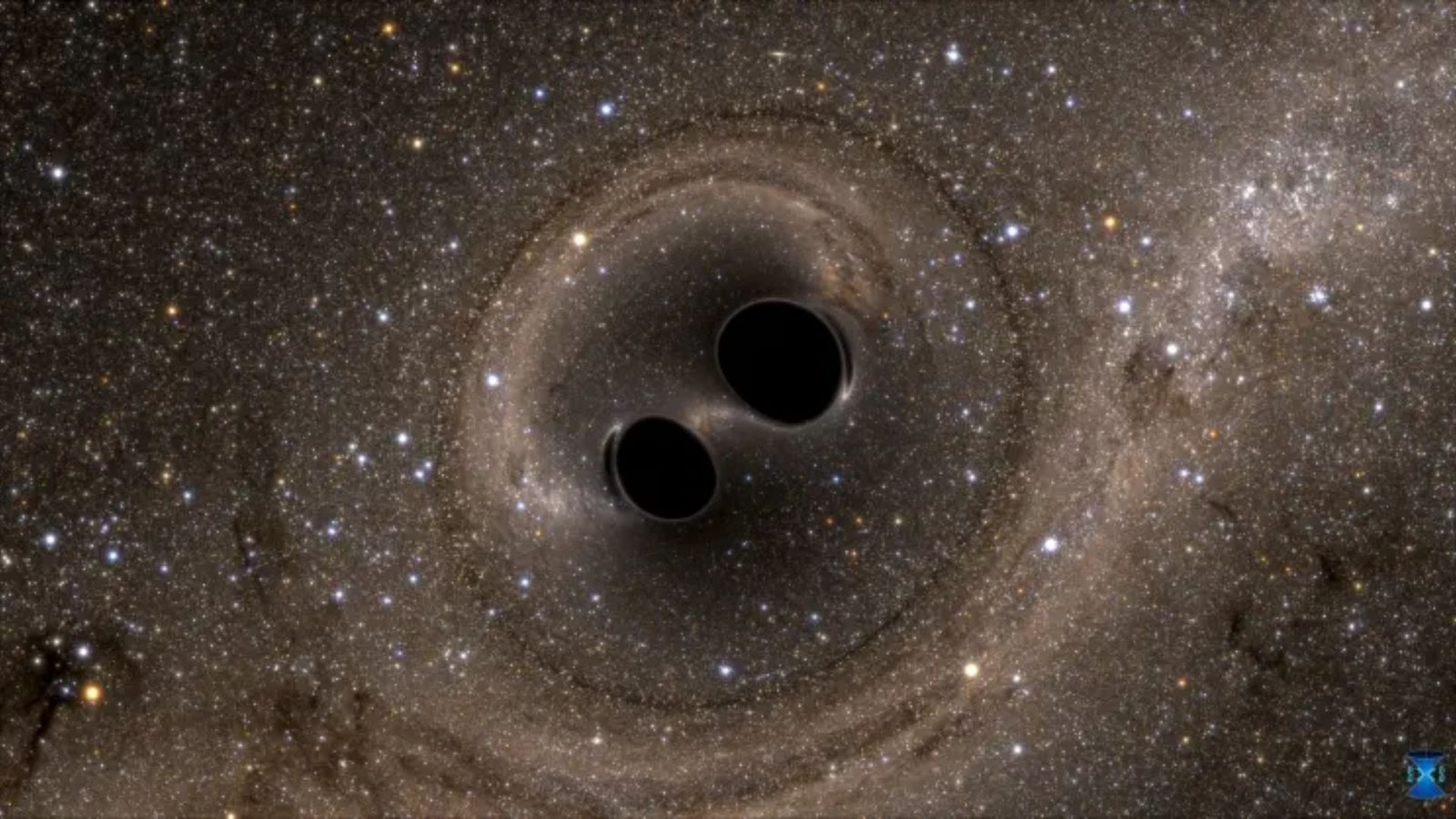
In a groundbreaking achievement, Finnish astronomers have captured the first-ever image of two supermassive black holes orbiting each other. This discovery, made possible by years of dedicated observation and advanced imaging techniques, provides invaluable insights into the dynamics of black hole mergers and their role in galaxy evolution. The research, published in a leading astrophysics journal, marks a significant step forward in our understanding of these cosmic giants.
The binary black hole system, located billions of light-years away, was identified through subtle variations in the light emitted from the surrounding accretion disk. These variations, analyzed using sophisticated algorithms, revealed the presence of two distinct sources of gravitational pull, confirming the existence of the orbiting black holes. The image itself, though not a direct visual representation, is a composite generated from radio wave data, showing the distinct structures and interactions within the system.
Significance of the Discovery
The importance of this discovery lies in its potential to validate current theoretical models of black hole mergers. Scientists believe that these mergers are a major source of gravitational waves, ripples in spacetime that propagate throughout the universe. By studying the dynamics of orbiting black holes, researchers can refine their predictions about the frequency and intensity of these gravitational waves, enhancing our ability to detect and interpret them using advanced observatories like LIGO and Virgo.
Furthermore, the imaging of this binary black hole system offers a unique opportunity to study the accretion process, where matter spirals into the black holes, releasing tremendous amounts of energy in the form of radiation. This radiation can influence the evolution of the host galaxy, affecting star formation and gas dynamics. Understanding this feedback mechanism is crucial for comprehending the co-evolution of black holes and galaxies.
Future Research Directions
The Finnish team plans to continue monitoring the binary black hole system, tracking its orbital evolution and searching for evidence of gravitational wave emission. They also hope to extend their imaging techniques to other candidate binary black hole systems, aiming to build a comprehensive catalog of these cosmic dance partners. This research will not only deepen our understanding of black hole physics but also shed light on the fundamental processes that shape the universe.
The successful imaging of the orbiting black holes showcases the power of collaborative research and technological innovation in pushing the boundaries of astronomical knowledge. As observational capabilities continue to improve, we can anticipate even more remarkable discoveries that will challenge and refine our understanding of the cosmos.
Image Source: Google | Image Credit: Respective Owner