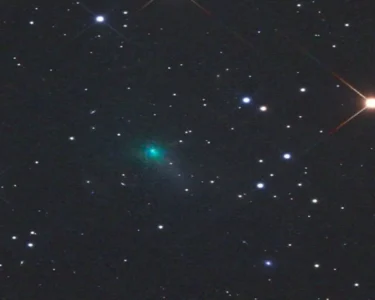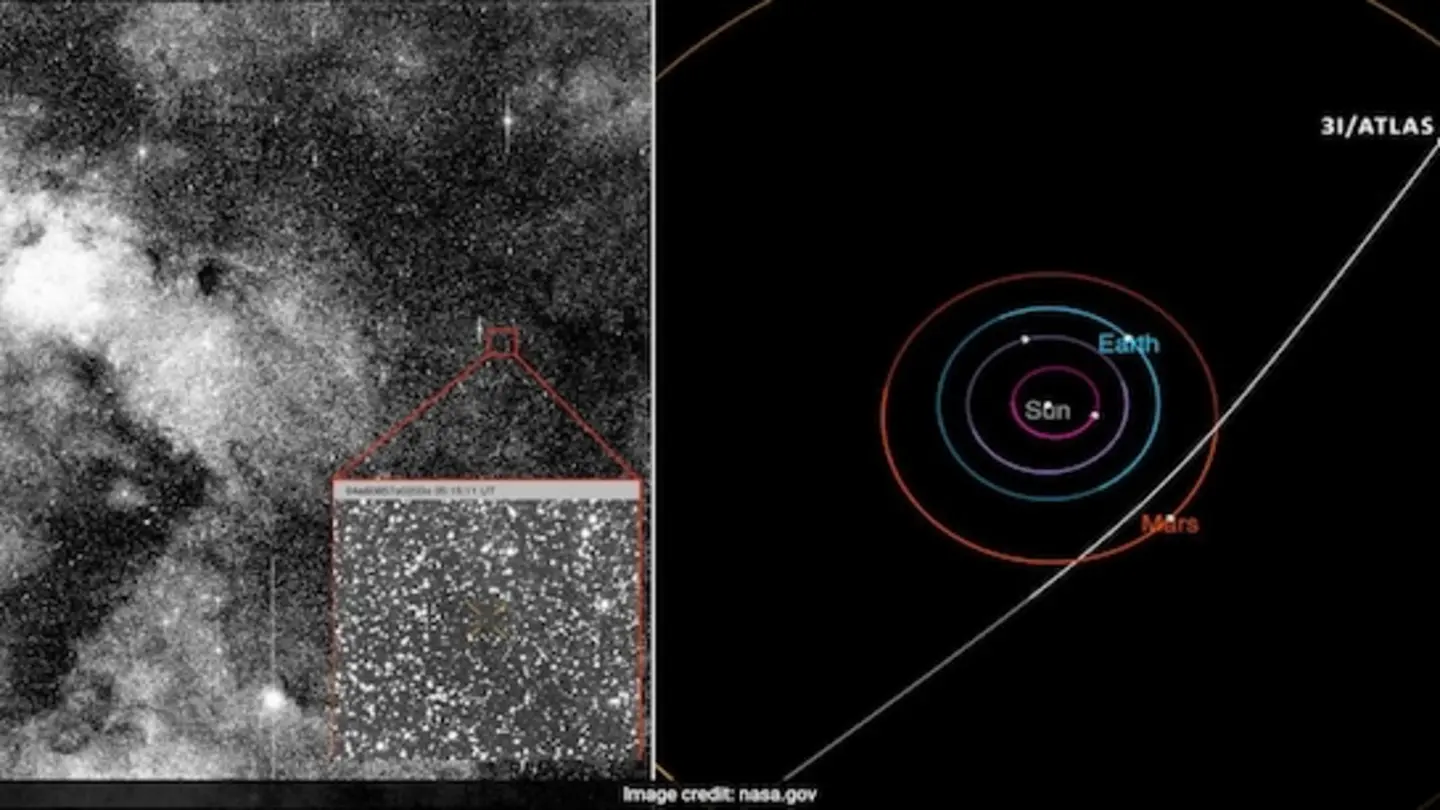
Comet 3I/ATLAS, an interstellar visitor traversing our solar system, is poised to vanish from telescopic view in the coming months before making a reappearance in November 2025. This celestial object, originally discovered in 2017, has captivated astronomers with its unique origin and trajectory, offering a rare glimpse into planetary systems beyond our own.
Observations indicate that 3I/ATLAS is currently receding from the Sun and Earth, diminishing in brightness as it journeys further into the outer reaches of the solar system. This fading visibility marks the end of the current observation window for most ground-based telescopes, as the comet becomes increasingly difficult to detect against the background of distant stars and galaxies. However, astronomers eagerly anticipate its return in late 2025, when it will once again approach the Sun and brighten sufficiently for observation.
A Glimpse Beyond Our Solar System
The interstellar nature of 3I/ATLAS sets it apart from typical comets originating within our solar system’s Kuiper Belt or Oort Cloud. Its hyperbolic trajectory, exceeding the Sun’s gravitational pull, confirms that it originated from another star system and is merely passing through our cosmic neighborhood. This makes it a valuable subject for scientific study, providing insights into the composition and characteristics of planetary systems orbiting distant stars.
During its previous close approach, astronomers utilized various telescopes and instruments to analyze 3I/ATLAS’s composition, size, and rotation. Spectroscopic analysis revealed the presence of various molecules, including water ice, carbon monoxide, and other volatile compounds, similar to comets found within our own solar system. However, subtle differences in the isotopic ratios of these molecules could provide clues about the comet’s birthplace and the conditions prevalent in its parent star system.
Future Observations
The anticipated return of 3I/ATLAS in 2025 presents a renewed opportunity for astronomers to conduct further research and refine our understanding of interstellar objects. Advanced telescopes, both ground-based and space-based, will be employed to capture high-resolution images and spectra of the comet, potentially revealing finer details about its structure and composition. Furthermore, ongoing theoretical studies and simulations will help to model the comet’s behavior and predict its future trajectory as it continues its interstellar voyage. The study of objects like 3I/ATLAS will inevitably contribute to our evolving understanding of planet formation and the potential for life beyond our solar system.
The eventual fate of 3I/ATLAS remains uncertain, as it is destined to eventually exit our solar system and travel into the vast expanse of interstellar space. However, the data collected during its brief visit will undoubtedly contribute to our broader knowledge of the universe and the diversity of celestial objects that populate it. The comet’s disappearing act is only temporary, and its reappearance in 2025 will be eagerly awaited by the astronomical community and space enthusiasts alike. The ongoing exploration and analysis of interstellar objects, such as comet 3I/ATLAS, allows scientists to piece together the history of our galaxy and the origins of the building blocks that make up planetary systems.
Image Source: Google | Image Credit: Respective Owner