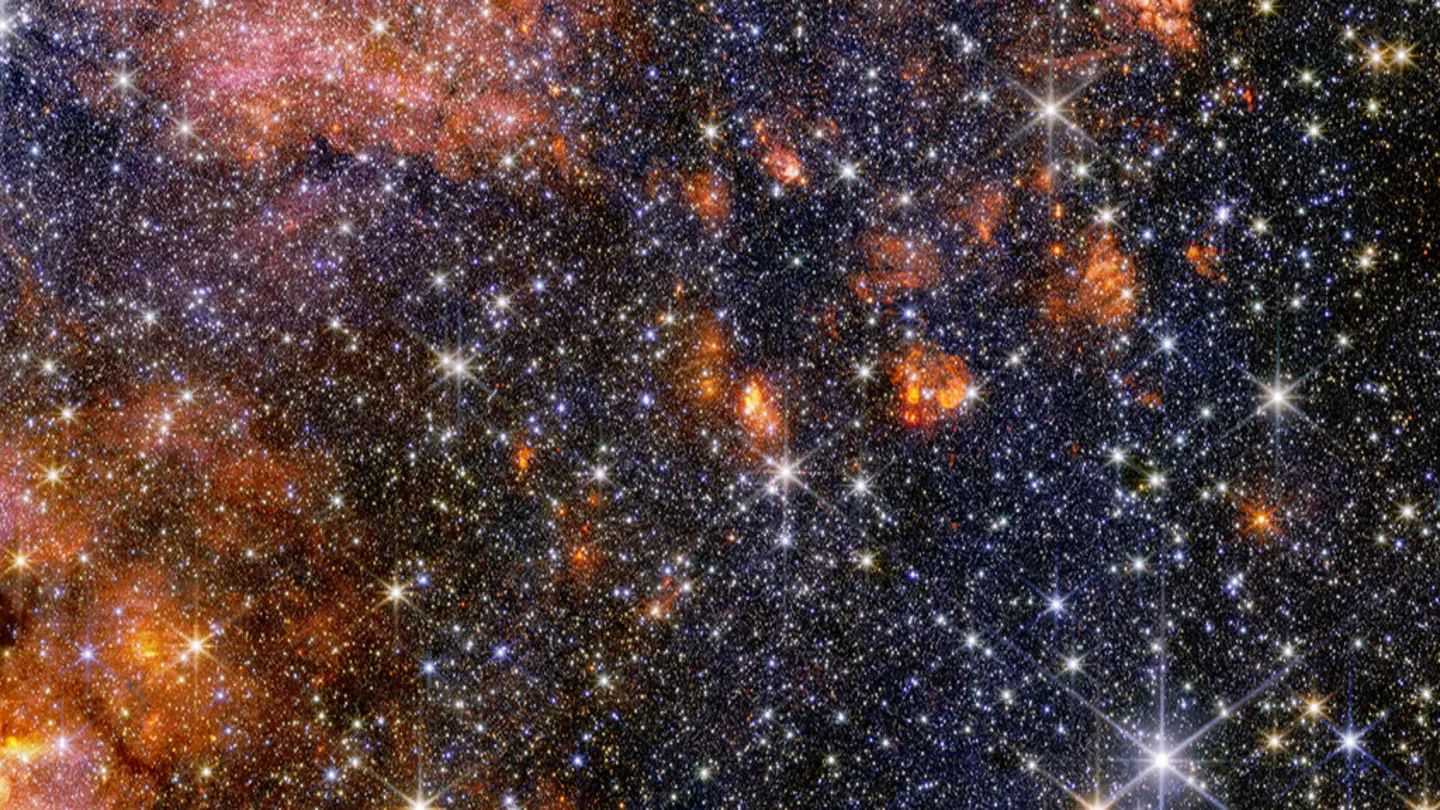
The James Webb Space Telescope (JWST) has provided unprecedented views into the heart of star formation within our own Milky Way galaxy. These observations offer invaluable insights into the earliest stages of stellar birth, a process that has long captivated astronomers. Using its advanced infrared capabilities, the JWST can penetrate the dense clouds of dust and gas that typically obscure star-forming regions from optical telescopes, revealing intricate details of nascent stars and their surrounding environments.
Unveiling the Stellar Nursery
The specific region targeted by the JWST observations is a particularly active stellar nursery, characterized by a high concentration of molecular gas and dust. This material serves as the raw ingredients for star formation, collapsing under gravity to form protostars. The JWST’s observations have captured the intricate structures within these clouds, including filaments, clumps, and dense cores where stars are actively being born. These details provide crucial clues about the physical processes governing star formation, such as the role of turbulence, magnetic fields, and feedback from young stars.
One of the key advantages of the JWST is its ability to observe in the infrared, which allows it to detect the faint heat signatures emitted by protostars embedded within the dust clouds. These protostars are often shrouded in thick cocoons of gas and dust, making them invisible to optical telescopes. By peering through these obscuring layers, the JWST can directly image these young stars and study their properties, such as their mass, temperature, and luminosity.
Furthermore, the JWST’s high spatial resolution enables astronomers to resolve the fine-scale structure of the gas and dust surrounding the protostars. This includes observations of protoplanetary disks, which are swirling disks of gas and dust that orbit young stars and are the birthplace of planets. By studying the composition and structure of these disks, astronomers can gain insights into the processes that lead to the formation of planetary systems.
The data collected by the JWST is expected to revolutionize our understanding of star formation and planet formation. It will help to address fundamental questions about the origins of stars, the conditions necessary for planet formation, and the diversity of planetary systems in our galaxy. The JWST’s observations will also provide valuable context for understanding the formation of our own solar system and the origins of life on Earth.
In addition to its observations of star-forming regions, the JWST is also being used to study a wide range of other astronomical phenomena, from the atmospheres of exoplanets to the most distant galaxies in the universe. Its powerful capabilities are transforming our understanding of the cosmos and ushering in a new era of astronomical discovery. As more data from the JWST becomes available, we can expect even more groundbreaking insights into the workings of the universe.
These new images and data are already being analyzed by teams of astronomers around the world, and the first scientific results are expected to be published in the coming months. The James Webb Space Telescope continues to prove its worth as a groundbreaking instrument, pushing the boundaries of our knowledge and inspiring future generations of scientists and explorers.
Image Source: Google | Image Credit: Respective Owner