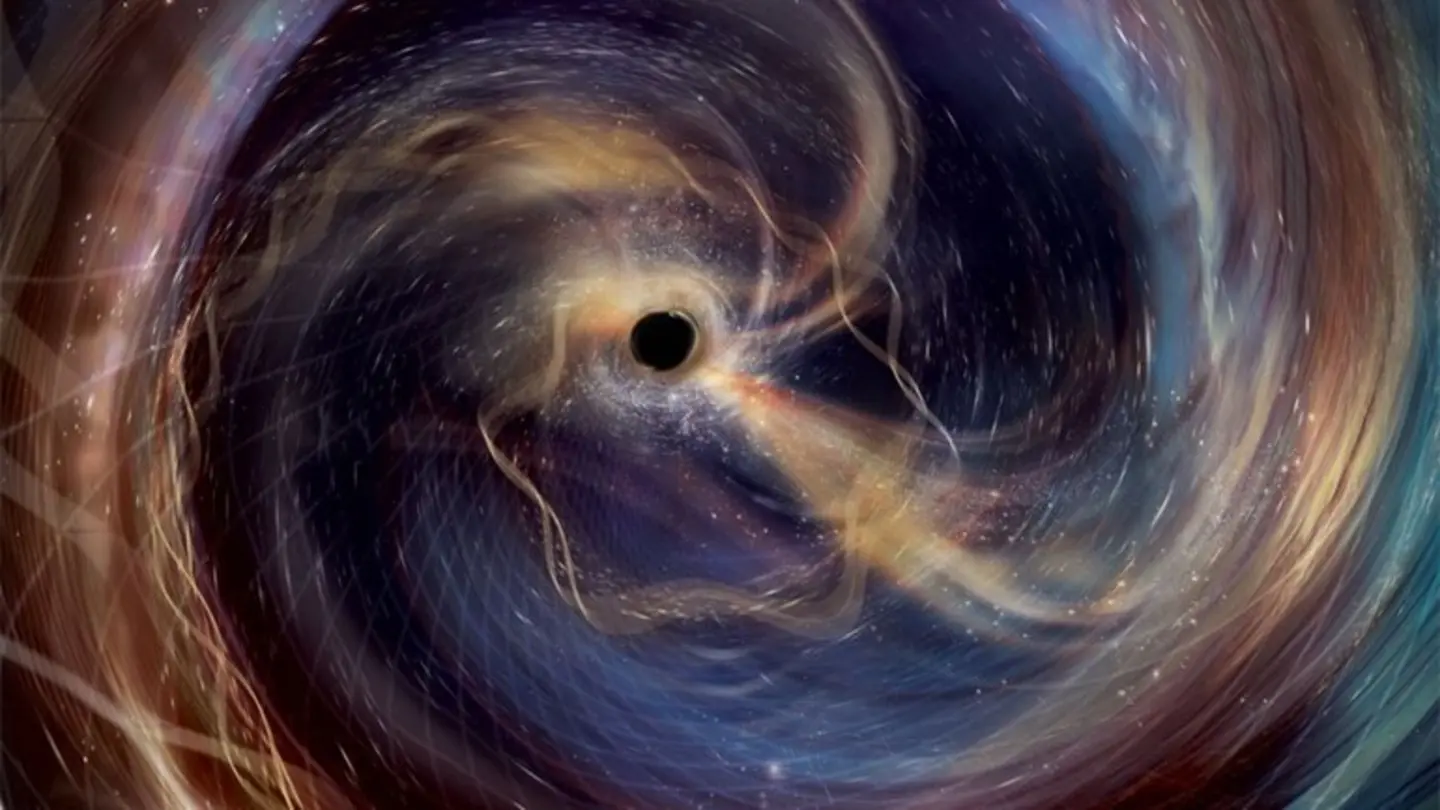
NASA has released a stunning image depicting the collision of two rotating black holes, an event known as GW250114. The image provides a visual representation of the gravitational waves emitted during the merger, offering valuable insights into the dynamics of these extreme cosmic phenomena. The event, detected on January 14, 2020, was a significant observation for scientists studying black hole mergers and gravitational wave astronomy.
Understanding GW250114
GW250114 refers to the specific gravitational wave signal detected by the Laser Interferometer Gravitational-Wave Observatory (LIGO) and Virgo detectors. These detectors are designed to capture the minute ripples in spacetime caused by cataclysmic events such as black hole collisions. The detected signal allows scientists to analyze the properties of the black holes involved, including their masses, spins, and the distance to the event.
The collision of black holes is one of the most energetic events in the universe. As the black holes spiral towards each other, they emit gravitational waves, which propagate through space at the speed of light. These waves carry information about the black holes and their interactions. The merger of two black holes results in a single, larger black hole, along with a burst of gravitational energy. The resulting black hole’s mass is less than the sum of the original black holes, with the “missing” mass converted into energy radiated away as gravitational waves.
NASA’s visualization helps to illustrate the complex process. The swirling patterns and distortions represent the spacetime fabric being warped by the immense gravity of the black holes. The colors often used in these visualizations may represent the intensity of the gravitational waves or other physical properties.
Significance of the Discovery
The detection and study of events like GW250114 contribute significantly to our understanding of black holes, gravity, and the evolution of the universe. By analyzing the gravitational wave signals, scientists can test Einstein’s theory of general relativity in extreme conditions and learn about the population of black holes in the cosmos. The data also helps refine models of black hole formation and merger processes.
Gravitational wave astronomy is a relatively new field, having made its first direct detection in 2015. Since then, numerous black hole mergers and neutron star collisions have been observed, providing a wealth of data for researchers. Future gravitational wave observatories, both on Earth and in space, promise to further expand our knowledge of the universe and its most enigmatic objects.
The image shared by NASA serves as a powerful reminder of the ongoing exploration of the universe and the remarkable discoveries being made through advanced scientific instruments and techniques. Such events continue to inspire awe and drive further research into the fundamental laws of physics.
Image Source: Google | Image Credit: Respective Owner