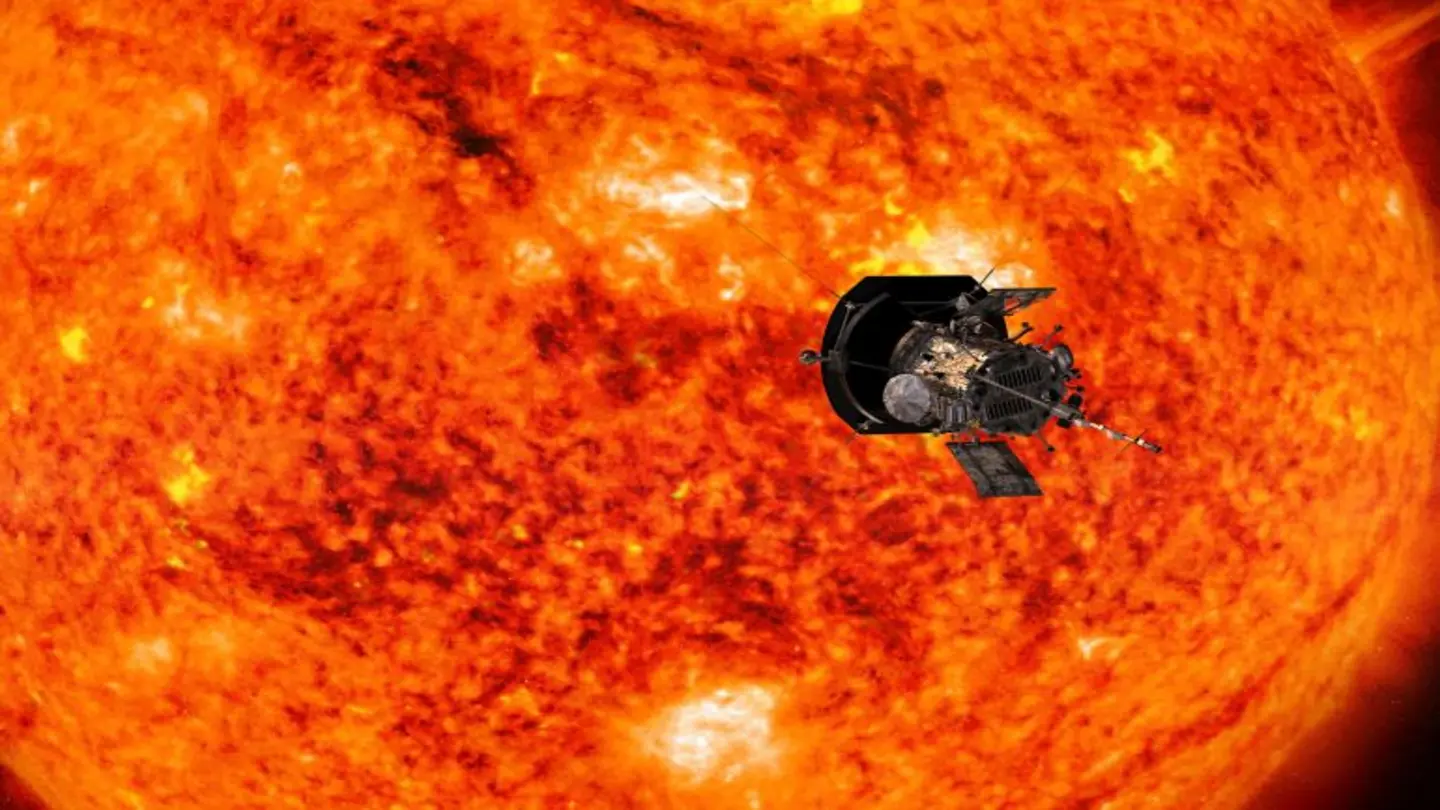
NASA’s Parker Solar Probe has achieved a remarkable speed, reaching velocities that allow it to travel from Kashmir to Kanyakumari in approximately 19 seconds. This incredible feat highlights the probe’s unprecedented journey through the Sun’s corona, gathering critical data about our star. The Parker Solar Probe, launched in 2018, is designed to study the Sun up close, braving extreme heat and radiation to unlock the mysteries of the solar wind and the Sun’s magnetic field.
The probe’s elliptical orbit brings it closer to the Sun than any spacecraft before, allowing it to directly sample particles and magnetic fields in the solar corona. During its closest approaches, the probe experiences temperatures exceeding 1,300 degrees Celsius (2,370 degrees Fahrenheit). To withstand this extreme environment, the Parker Solar Probe is equipped with a state-of-the-art heat shield that protects its sensitive instruments.
Unprecedented Speed and Data Collection
The Parker Solar Probe’s speed is not just a record; it’s a crucial aspect of its mission. The high velocity allows the probe to escape the Sun’s gravity and maintain its orbit, while also enabling it to collect data more efficiently. As the probe whips around the Sun, it gathers information about the solar wind, a stream of charged particles constantly emitted by the Sun. Understanding the solar wind is essential for predicting space weather, which can impact Earth’s communication systems, satellites, and power grids.
The data collected by the Parker Solar Probe has already revolutionized our understanding of the Sun. Scientists have gained new insights into the structure and dynamics of the solar corona, the origin of the solar wind, and the mechanisms that heat the corona to millions of degrees. These findings are helping us to better understand the Sun’s influence on the solar system and its potential effects on Earth.
Implications for Future Missions
The success of the Parker Solar Probe has paved the way for future missions to explore other extreme environments in space. The technologies developed for the probe, such as its heat shield and radiation-hardened electronics, are being adapted for use in other spacecraft designed to study planets and moons closer to the Sun, or those exposed to intense radiation belts. The Parker Solar Probe’s legacy will extend far beyond its own mission, inspiring future generations of scientists and engineers to push the boundaries of space exploration.
The probe continues to make closer and faster flybys of the Sun, constantly refining our knowledge of this essential star. This bold mission exemplifies humanity’s relentless quest to comprehend the universe and our place within it. It is a testament to human ingenuity and our determination to explore the unknown, even in the face of extreme challenges.
Image Source: Google | Image Credit: Respective Owner